Learning management
Control what people need to learn, when it must be completed and how completion is evidenced.
TUTORize combines learning management, knowledge management and skill management on one shared platform.
This turns individual training courses, knowledge resources and competency data into manageable processes: with clear responsibilities, traceable workflows and reliable evidence.
TUTORize ISO 27001 certified · GDPR compliant · Hosted in Germany · Multitenant · SSO & REST API · AI optional
Explore the productsAn LMS does not automatically answer which knowledge is current and approved. A knowledge base does not show which qualification is missing for a role. And a skill matrix does not close a competency gap on its own.
TUTORize brings these tasks together on a shared organisational and technical basis.
This allows users, roles, structures and permissions to be used consistently throughout the system, while each module fulfils its own specialist purpose.
Control what people need to learn, when it must be completed and how completion is evidenced.
Document which knowledge is valid, who is responsible for it and when it must be reviewed or updated.
Define which competencies are required, assess existing skills and identify qualification needs.
The result is not a collection of individual features, but a platform for controllable learning, knowledge and qualification processes.
TUTORize supports digital training, learning paths as well as online and in-person events. Target groups, timing, repetitions and progress are controlled centrally.
This creates a traceable qualification process from individual learning opportunities.
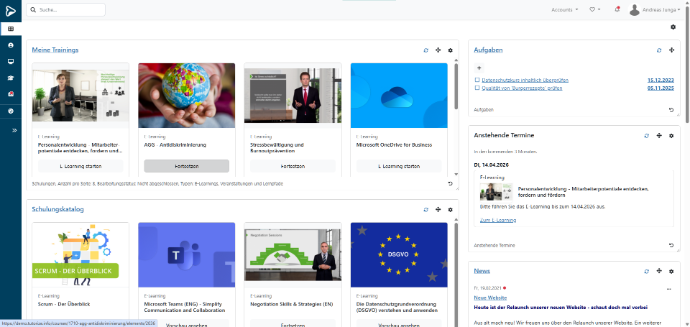
Build e-learning with text, documents, video, audio, tests and established learning standards.
Combine digital content and events in learning paths and deliver them in a defined sequence.
Use system-supported reminders, repetitions and time-dependent learning processes.
Organise events, dates, participants, rooms, capacities, approvals and waiting lists.
Filter, analyse and export learning records, completions and results for internal or external evidence requirements.
Company knowledge loses its value when no one can reliably say which version applies, who is responsible or when information was last reviewed.
TUTORize knowledge management combines structured knowledge entries with approval, versioning, search and quality management.
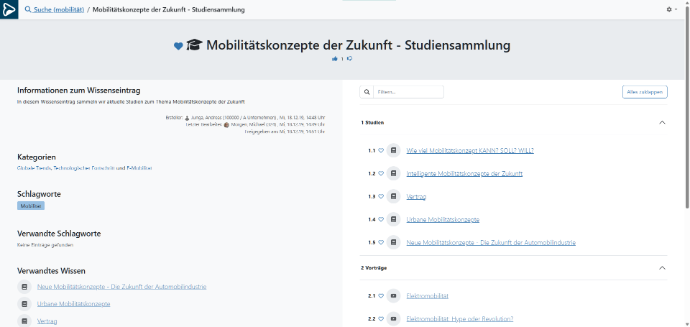
Document and categorise processes, instructions, specialist knowledge and internal information centrally.
Edit and review new versions while the previously approved version remains valid.
Define responsibilities and regular review dates so that content does not become outdated unnoticed.
Provide easy access to approved content through system-wide search, categories and filters.
Connect tasks and discussions to specific knowledge content and make responsibilities visible.
Competencies only become manageable when it is clear what a role requires and what level employees actually possess.
TUTORize connects skills, job requirements, assessments, employee discussions and learning opportunities in a traceable qualification process.
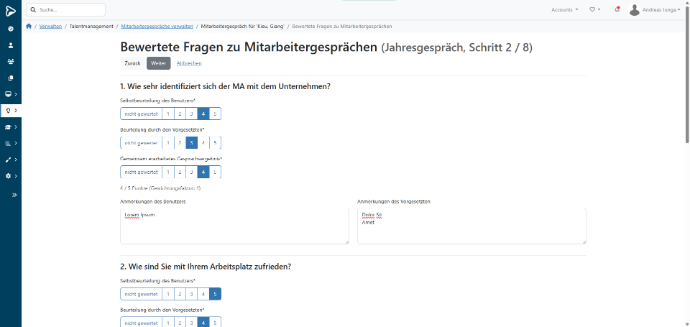
Define competencies and suitable proficiency levels and use them in jobs and training courses.
Specify which skills and proficiency levels are needed for a position.
Compare self-assessments, manager assessments and system-determined competency levels with the job profile.
Make missing competencies visible and identify suitable existing training courses.
Prepare structured employee discussions, discuss skill assessments and document agreed measures.
Search for people with specific skills or suitable competency profiles.
TUTORize keeps learning management, knowledge management and skill management clearly separated as specialist functions. At the same time, they share one platform for users, organisations, roles and permissions.
This allows meaningful processes to be connected across module boundaries.
A position defines the required competencies.
The target–actual comparison shows which skills are missing.
TUTORize can identify existing training courses for those gaps and initiate qualification directly.
Training courses are assigned to target groups and given timing or repetition rules.
Progress and completions remain centrally traceable and can be analysed or exported.
Knowledge entries are created, reviewed and approved.
Changes are first prepared as a new version without overwriting the currently valid version.
Review dates ensure that knowledge is checked regularly.
Learning, knowledge and competencies thus remain distinct specialist tasks without diverging into separate system environments.
The product modules rely on the same fundamental platform architecture.
This means central structures do not have to be rebuilt and maintained for each module.
Explore the platformManage companies, groups, user profiles and individual profile data centrally.
Use global and local roles and restrict access to specific areas of responsibility.
Represent separate accounts and organisational environments within one centrally manageable platform.
Manage documents, images, videos and other media centrally and use them across different content.
Search learning and knowledge content system-wide and use tasks, news and other collaboration features.
A platform for learning, knowledge and qualification processes must do more than work as a specialist application. It must fit into existing identity, organisational and security structures.
TUTORize supports connecting existing systems through REST API, webhooks, SSO as well as import and learning standards.
Identities, user structures and other relevant data therefore do not have to be managed separately in the LMS.
Explore integrationsHosting in Germany, multitenancy, role and permission models, SSO and additional access protection functions support controlled operation, including in environments with higher governance requirements.
Explore securityAI supports defined tasks in learning and knowledge processes, for example when creating or preparing content.
These functions are optional and are deliberately not treated as prerequisites for operating the platform.
Explore AI in TUTORizeRoll out recurring training in a structured manner, track deadlines and document completion statuses transparently.
Systematically qualify new employees through defined learning programmes and role requirements.
Document, review, approve and keep organisational knowledge up to date.
Make competency requirements visible, identify skill gaps and derive suitable continuing education.
Which processes and capabilities TUTORize supports.
Background knowledge, assessments and best practices.
How to perform specific tasks in TUTORize, step by step.
In a demo we do not simply run through a list of features.
We look at your target groups, learning and knowledge processes, competency requirements, integrations and governance specifications, and show how they can be represented in TUTORize.